
One challenge I encounter with discussion-based learning is that each class inevitably has a handful (or more) of students who are less comfortable contributing verbally. My goal in supporting these students is both to find outlets for them to share in ways that work for them while also guiding them toward becoming full discussion participants.
One strategy in this effort is the dialectical notebook, which I sometimes simply call the “silent discussion.”
What is a dialectical notebook? How does it support student engagement?
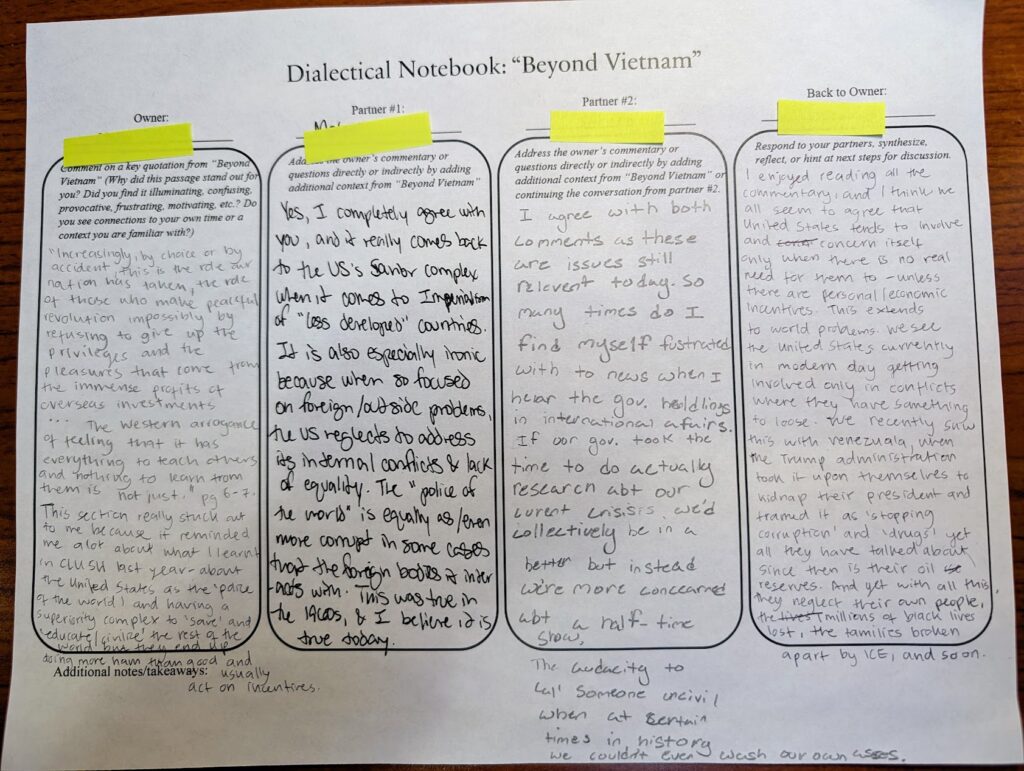
A dialectical notebook is a structured written conversation in which students engage with a text through multiple rounds of response, building on each other’s thinking in sequence. Meaning emerges through the exchange of different perspectives rather than from any single reading.
The exercise ensures every student engages with the text in writing before any whole-group discussion begins, which lowers the barrier to participation and gives students with less practice or confidence a voice they might not claim at the table. This exercise also externalizes the interpretive process in the sense that students can see (in writing) how their reading of a passage gets complicated, affirmed, or redirected by peers, which models the kind of intellectual dialogue you want them to internalize. Also, because each round builds on the previous one, it pushes students beyond initial reactions toward more layered analysis.
How do I use this model?
The short version is that this works any time students have a chance to respond to a text, then pass their response (“notebook”) so that partners engage with and extend that initial response, before it returns to the original author for synthesis.
Here’s a breakdown of how I used it for a lesson on Martin Luther King, Jr.’s 1967 speech, “Beyond Vietnam: A Time to Break Silence” (adapted for classroom use). First, students were asked to read a slightly modified version of the speech for homework.
To make sense of the speech, students will need context. For my Philosophy of Nonviolence course, students know King primarily as a civil rights leader, so will need some added context on the escalating conflict in Vietnam, the factors that compelled him to speak out against the conflict, and the costs of doing so. I aim to keep this brief (five minutes—perhaps ten if students add additional context or have questions).
Students then take turns reading aloud a few selected quotations from the passage. Doing so is intended to provide a straightforward entry point to make this exercise accessible for everyone (another version of this exercise might be to have students highlight and then nominate quotations themselves).
With a more advanced class I might have skipped or modified this step:
- “We have been repeatedly faced with the cruel irony of watching Negro and white boys on TV screens as they kill and die together for a nation that has been unable to seat them together in the same schools. And so we watch them in brutal solidarity burning the huts of a poor village, but we realize that they would hardly live on the same block in Chicago.” (p. 2).
- “I could never again raise my voice against the violence of the oppressed in the ghettos without having first spoken clearly to the greatest purveyor of violence in the world today—my own government” (p. 2).
- “We are called to speak for the weak, for the voiceless, for the victims of our nation and for those it calls ‘enemies’, for no document from human hands can make these humans any less our brothers” (p. 4).
- “Here is the true meaning and value of compassion and nonviolence, when it helps us to see the enemy’s point of view, to hear his questions, to know his assessment of ourselves” (p. 5).
- “The words of the late John F. Kennedy come back to haunt us. Five years ago he said, ‘Those who make peaceful revolution impossible will make violent revolution inevitable” (p. 6).
Finally, I ask students to jot down a reflection to one (or more) of the quotations above, to another passage they felt compelling, or to address a question they had in mind. I time this exercise fairly loosely. When only a couple of students are done writing I let them know they have about 30 seconds to wrap up. After each round students pass the sheet they are writing on to the left. After doing so twice, the paper is returned to the original author to synthesize and respond.
When this is complete the goal is to have about 10-15 minutes to move the discussion from the paper to the table.
At the end of class I collect student writing so I can compare how they are contributing verbally to discussion with this written evidence. This can be especially helpful for following up with students who are a bit more reticent, talking through with them individually how they might draw on one or more of their comments to offer their perspective in discussion.
Leave a Reply