
As I’ve been reflecting on how to improve the quality of discussion in my own classroom, I found myself returning to a taxonomy I encountered years ago in an article I can no longer place. It was a simple chart that mapped various forms of student-centered learning along two axes: teacher expertise and student agency. My initial goal was to reproduce it as a quick visual, but the process raised a more interesting question: when is each approach most useful? I know from experience that the “purest” student-centered models are not always the most effective or responsible ways to introduce dense, new content. What other conditions might call for variation? If I genuinely believe that most forms of instruction have their place, how does that belief play out specifically for discussion?
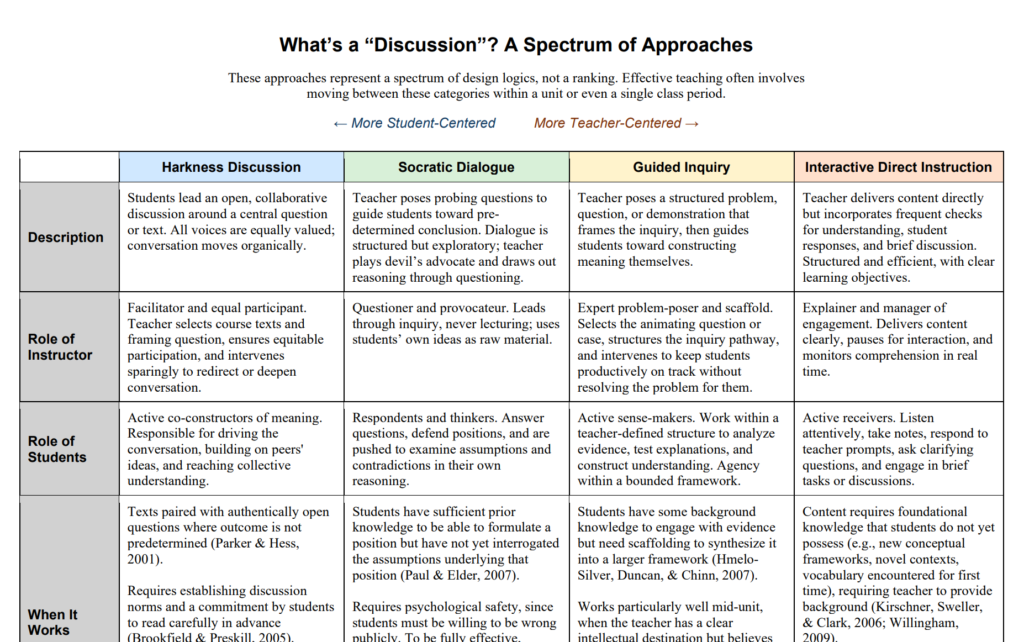
To make sense of this, I’ve built and expanded on that original taxonomy, looking at what the research literature says about the specific conditions under which each approach thrives, from robust student-led Harkness discussions to carefully-scaffolded cases of interactive direct instruction. Included for each is a description, the role of the instructor, the role of students, suggestions about when it works best, and examples from three Humanities disciplines: philosophy, history, and literature.
The resulting chart represents this spectrum of design logics. It is intentionally not ranked from “bad” to “good.” It’s a map meant to help us move with intention between different modes of inquiry based on our students’ needs and the goals of the unit.
Leave a Reply